Practical Python Programming Course for GCSE & A-Level Age Students
Go Beyond Coding on a Screen. Learn Python by Interacting with the Real World.
Are you already learning Python at school but want to take your programming skills further? Would you like to build programs that interact with sensors, displays, motors, beepers and electronic devices rather than simply printing text to a console?
This practical Python programming course has been designed specifically for ambitious programmers who already have a working knowledge of Python and are ready to develop their skills further through a series of practical and progressively challenging projects. It is particularly suited for young innovators keen to gain exposure to robotics and automated systems.
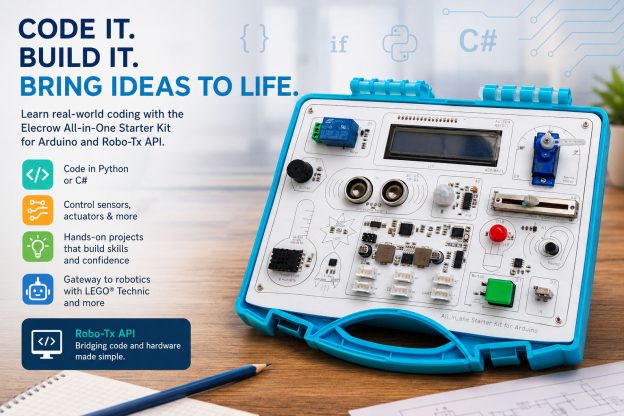
Unlike traditional coding courses that focus almost entirely on abstract programming exercises, this course goes beyond with engaging, real-world projects using sensors and actuators connected to Arduino hardware via a specialised API designed for robotics learning. Every assignment has a practical purpose. Every program interacts with real electronic devices. Students don’t just write code—they see it come to life.
Why Choose This Python Programming Course?
Many Python courses introduce programming concepts using console-based examples such as simple games or text-only exercises. While these are useful for learning syntax, they often provide little insight into how software controls and interacts with the physical world.
This course takes a different approach.
Students employ exactly the same core Python programming concepts—including variables, loops, functions, conditionals, lists, strings, file handling and searching—but apply them to practical engineering challenges involving sensors, displays, motors and electronic devices.
By connecting software with hardware, students gain a deeper understanding of how programs respond to real-world events, process data from sensors, make decisions and control outputs. This practical approach makes learning more engaging, reinforces problem-solving skills and helps students appreciate how Python is used in robotics, embedded systems, automation and engineering applications.
What Will Students Build?
Using our course textbook, students complete a series of progressively challenging programming assignments. Each assignment begins with a realistic engineering challenge.
Projects include:
- Push-button controlled electronic systems
- Motion-activated security lighting
- Automatic windscreen wiper simulation using a servo motor
- Electronic PIN code entry system
- Scrolling information display
- Morse code transmitters with audible beeps
- Sonar-based movement detector
- Digital spirit level using motion sensor
Projects introduce new programming techniques while reinforcing skills developed in earlier exercises. By the end of the course, students will have developed a substantial portfolio of practical Python programs that interact with a wide range of electronic sensors and actuators. Students also gain experience reading technical documentation and adapting existing code—essential skills used by professional software developers.
Flexible Learning Approach
The course combines independent study with personalised tutor support. Students prepare a program design for one or more programming tasks in the form of pseudo code before attending supervised practical sessions. More ambitious students may also want to prepare a first attempt at a Python solution.
During each session, students:
- Implement their Python solution;
- Test their program using real hardware;
- Debug any problems;
- Receive guidance from the tutor;
- Discuss alternative coding approaches; and
- Receive feedback on both their coding style and final solution.
This combination of preparation, practical application, and tutor support is intended to strengthen understanding and build confidence in the development of effective programming solutions. Typical online session length is 40 minutes, and prices depend of whether sessions are block or singly booked.
Students will require:
- A desktop computer or laptop with a suitably sized screen for coding.
- A webcam and microphone.
- A reliable internet connection.
- A quiet study environment free from distractions.
No Special Hardware Needed
Students do not need to purchase any special hardware or robotics kit.
During supervised online sessions, students are provided with remote access to the Robo-Tx platform and Arduino-based hardware, allowing them to test their Python programs against real electronic devices from home. After completing the course, students will have the knowledge and confidence to explore Arduino and robotics independently and begin developing their own Python-controlled electronic projects.
Is This Course Right for You?
This course is ideal for students who:
- Are studying GCSE or A-Level Computer Science;
- Already have a working knowledge of Python;
- Want to strengthen their programming skills;
- Enjoy solving practical problems;
- Are interested in electronics, engineering or robotics; or
- Want to build confidence before progressing to more advanced programming projects.
Every student progresses at their own pace. Students who already have strong Python skills may complete the course in approximately 10 supervised sessions.
Students who require additional support can continue beyond this point until they have successfully completed all practical assignments. The emphasis is on achieving genuine understanding rather than completing the course within a fixed number of lessons.
About the Course Author
This Python Programming course has been created by Kashif Baig, an IT professional with more than 30 years of industry experience spanning enterprise software development, data warehousing, analytics and reporting. Kashif is the author of Arduino Web Development: Pushing the Limits and has a long-standing passion for innovation, embedded systems, automation, and practical technology education.
The course has been designed to bridge the gap between academic programming and practical software engineering by giving students experience of developing programs that interact directly with hardware.
Enrol Today
Begin your journey into practical Python programming and robotics with a course that combines independent learning, personalised tuition and hands-on experience using real electronic hardware. Enrolment itself is free.
Develop the confidence, problem-solving ability and practical programming skills needed to become the next generation of technology innovators.
Please use the Contact Us form for information on how to enrol.